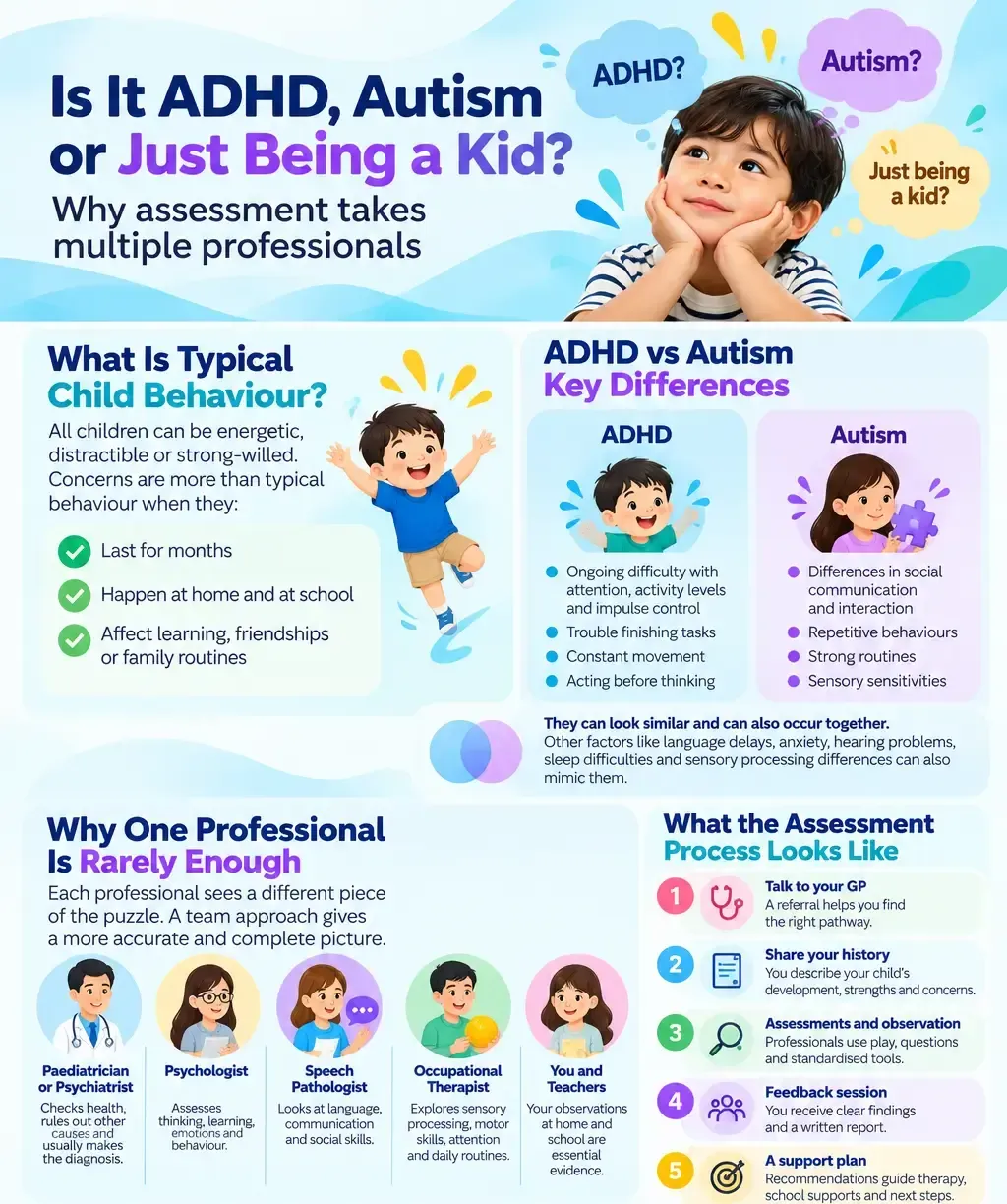

Is It ADHD, Autism, or Just Being a Kid? Why Assessment Takes Multiple Professionals
Your child struggles to sit still, melts down over small changes, or seems to live in their own world. Is it ADHD, autism, or simply being a kid? It is a question many parents ask us, and the honest answer is that it takes more than one opinion to know. This guide explains the differences and why a good assessment involves a team, for families in Smithfield, Fairfield, Auburn, Parramatta and across Western Sydney.
Is It Just Being a Kid?
All children can be energetic, distractible or strong-willed. What sets concerns apart is how long they last, how often they appear and how much they affect daily life. Ask yourself: Does it happen at home and at school? Has it continued for months? Is it getting in the way of learning, friendships or family routines? If the answer is yes, an assessment can help you understand what is going on.
ADHD and Autism: What Is the Difference?
- ADHD: Ongoing difficulty with attention, activity levels and impulse control, such as trouble finishing tasks, constant movement or acting before thinking.
- Autism: Differences in social communication and interaction, along with repetitive behaviours, strong routines or sensory sensitivities.
They can look similar and can also occur together. Language delays, anxiety, hearing problems, sleep difficulties and sensory processing differences can also mimic them, which is why guessing is risky.
Why One Professional Is Rarely Enough
No single test can answer the question. Each professional sees a different piece of the puzzle:
- Paediatrician or psychiatrist: Checks your child's health and development, rules out other causes and usually makes the diagnosis.
- Psychologist: Assesses thinking, learning, emotions and behaviour through formal assessments.
- Speech pathologist: Looks at language, communication and social skills with a speech pathology assessment.
- Occupational therapist: Explores sensory processing, motor skills, attention and daily routines through occupational therapy.
- You and your child's teachers: Your observations at home and school are essential evidence.
Putting these views together gives a far more accurate and useful picture than any one appointment. It also reduces the risk of a missed or incorrect label, and it means the recommendations you receive are practical for home, school and therapy.
What the Assessment Process Looks Like
- Talk to your GP: A referral helps you find the right pathway.
- Share your history: You describe your child's development, strengths and concerns.
- Assessments and observation: Professionals use play, questions and standardised tools.
- Feedback session: You receive clear findings and a written report.
- A support plan: Recommendations guide therapy, school supports and next steps.
Waitlists for some specialists can be long, and therapy does not have to wait for a diagnosis. Starting allied health support early can help your child in the meantime.
Where to Start
If you are worried about your child, you do not have to work it out alone. Whether you live in Smithfield, Fairfield, Auburn or Parramatta, our team can guide you through formal assessments and explain the results in plain English, with interpreter support available if you need it. Contact our friendly team or visit us in Smithfield or Guildford, and we will help you take the next step.
Frequently Asked Questions
At what age can a child be assessed for ADHD or autism?
Signs of autism can often be seen in the toddler years, and ADHD is commonly assessed once children start preschool or school, when demands on attention increase. If you have concerns at any age, talk to your GP or child health nurse.
Does my child need a diagnosis before starting therapy?
No. Therapy is based on your child's needs, so support can begin while you wait for a diagnosis. Some funding pathways may ask for diagnostic reports, so check what is required.
Can a child have both ADHD and autism?
Yes. The two can occur together, which is why a thorough assessment looks at attention, communication, sensory needs and emotions rather than focusing on one label.
Who can diagnose ADHD or autism?
ADHD is usually diagnosed by a paediatrician or psychiatrist, and autism may also be diagnosed by a psychologist. Speech pathologists and occupational therapists contribute important assessments. Your GP can advise on the right pathway.