My Child's NDIS Plan Has $X Left: What Can I Actually Spend It On?
It is a common worry for parents. You check your child's NDIS plan, see money left over, and are not sure what you can use it for before the plan ends. The good news is that there are usually more options than most families realise, as long as they fit your child's plan and goals. Here is a clear guide for families in Smithfield, Fairfield, Auburn, Parramatta and across Western Sydney.
First, Check What Your Plan Covers
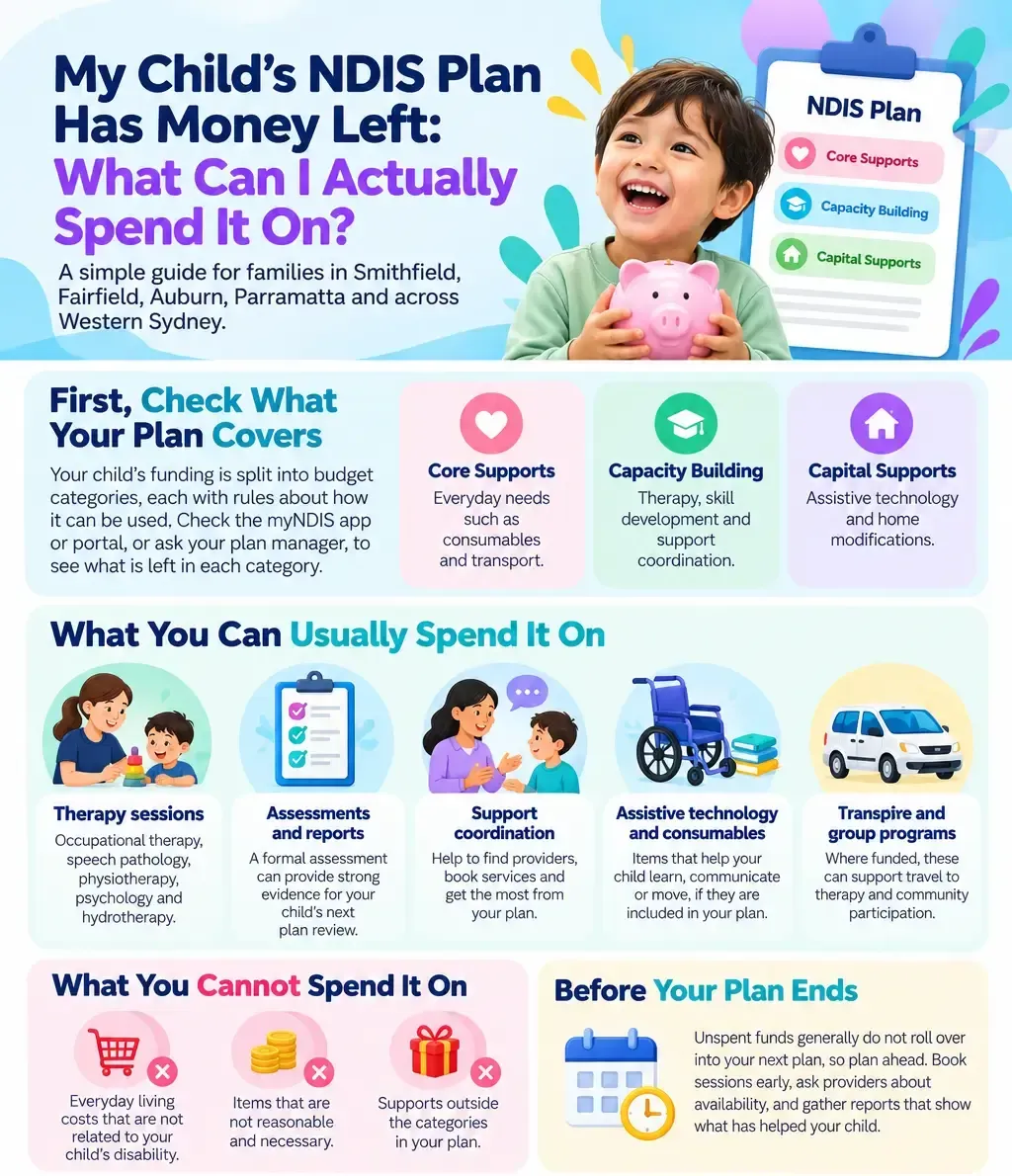
Your child's funding is split into budget categories, each with rules about how it can be used. Core Supports cover everyday needs such as consumables and transport. Capacity Building covers therapy, skill development, and support coordination. Capital covers assistive technology and home modifications. Spending must also be reasonable and necessary and linked to your child's disability and goals. Check the myNDIS app or portal, or ask your plan manager, to see what is left in each category. Funding is released in funding periods, generally three months, and unspent money rolls over to the next period within the same plan.
What You Can Usually Spend It On
- Therapy sessions: Occupational therapy, speech pathology, physiotherapy, psychology, and hydrotherapy can all be funded when they are in your plan.
- Assessments and reports: A formal assessment can provide strong evidence for your child's next plan review.
- Support coordination: Help to find providers, book services, and get the most from your plan.
- Assistive technology and consumables: Items that help your child learn, communicate, or move, if they are included in your plan.
- Transport and group programs: Where funded, these can support travel to therapy and community participation.
If you are unsure, confirm with your plan manager or the NDIS before booking.
What You Cannot Spend It On
Funds cannot cover everyday living costs that are not related to your child's disability, items that are not reasonable and necessary, or supports outside the categories in your plan.
Before Your Plan Ends
Unspent funds generally do not roll over into your next plan, so plan ahead. Whether you live in Smithfield, Fairfield, Auburn or Parramatta, book sessions early, ask providers about availability, and gather reports that show what has helped your child. Also note that Thriving Kids began rolling out from 1 October 2026 for children aged eight and under with developmental delay or autism with low to moderate support needs. Children already in the NDIS are not removed straight away, but it is worth checking how it may affect your child's plan.
Supporting Families Across Western Sydney
Every family comes to us with a different background, and we take the time to understand yours. We support children and families from Smithfield, Fairfield, Auburn, Parramatta and surrounding suburbs, from many cultural and language backgrounds.
Whatever your language or culture, we will explain your child's plan in plain terms. Ask us about interpreter support so every step is clear, and so you feel confident about how your child's funding is being used.
Not sure how to use the funding that is left? Contact our friendly team or visit us in Smithfield or Guildford, and we will help you build a plan.
Frequently Asked Questions
Do unspent funds roll over into my child's next plan?
Generally no. Unspent money rolls over between funding periods within the same plan, but it does not usually carry into a new plan. Check with the NDIS or your plan manager about your child's situation.
Can I spend the funding on anything that helps my child?
No. Supports must be reasonable and necessary, linked to your child's disability and goals, and fit the budget categories in the plan. If you are unsure, ask before you buy.
How do I check how much funding is left?
You can see your balance and spending in the myNDIS app or portal. If your plan is plan-managed, your plan manager can also give you a statement.
Will Thriving Kids change my child's current plan?
Not straight away. Children already in the NDIS stay in the scheme for now, although some children aged eight and under with low to moderate needs may be reassessed from 2028. Speak with the NDIS about your child's circumstances.