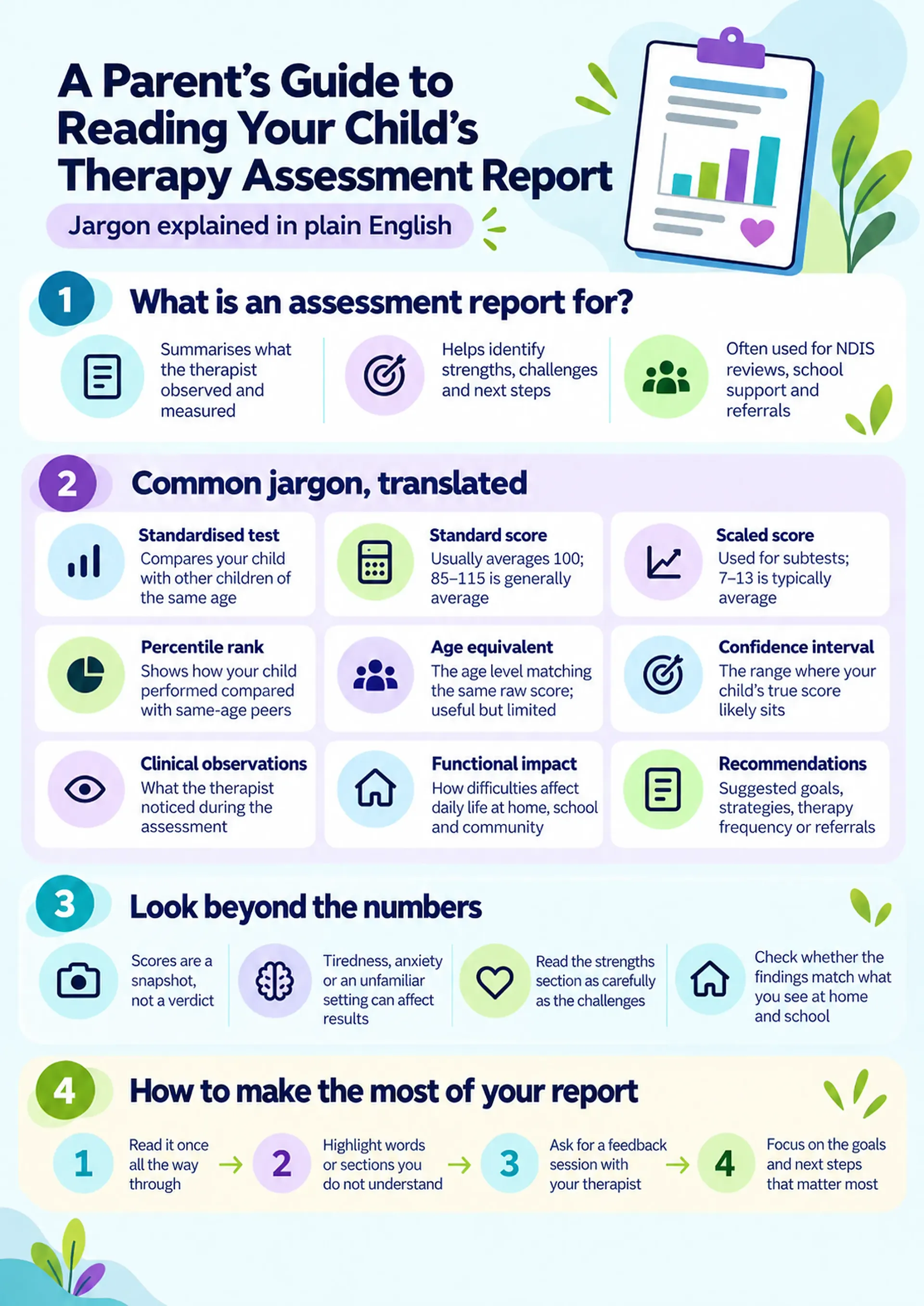

A Parent's Guide to Reading Your Child's Therapy Assessment Report: Jargon Explained
Opening your child's assessment report for the first time can feel overwhelming. Pages of scores, unfamiliar terms and clinical language can leave you wondering what it all really means. The good news is that a report is simply a detailed picture of your child's strengths and challenges, and once you can read it, it becomes a practical roadmap. At Thrive Kids, we regularly walk families across Smithfield, Guildford and Western Sydney through their results, so here is a plain-English guide.
What Is an Assessment Report For?
A therapy assessment report summarises what your therapist observed and measured. Most include background information, the tests used, results, a summary and recommendations. Whether it comes from an occupational therapist, speech pathologist or psychologist, the purpose is the same: understand how your child is going and decide what support will help most. Reports are also commonly used as evidence for NDIS plan reviews, school support and referrals, which is why our formal assessments are written to be clear and practical.
Common Jargon, Translated
Here are the terms parents ask us about most:
- Standardised test: Compares your child with a large group of same-age children. It is not a pass or fail.
- Standard score: Usually averages 100. Scores from 85 to 115 are generally considered within the average range.
- Scaled score: Used for subtests, with an average of 10. Scores of 7 to 13 are typically average.
- Percentile rank: Shows how your child performed against same-age peers. A percentile of 25 means they scored as well as or better than 25 out of 100 children. It is not a percentage mark.
- Age equivalent: The age at which an average child would achieve the same raw score. It can be misleading, so clinicians treat it with caution.
- Confidence interval: The range where your child's true score likely sits, because results can vary from day to day.
- Clinical observations: What the therapist noticed, such as attention, engagement and how your child approached tasks. These are often as valuable as the numbers.
- Functional impact: How any difficulties affect daily life at home, at school and in the community.
- Recommendations: Suggested goals, therapy frequency, strategies and referrals.
Look Beyond the Numbers
Scores are a snapshot, not a verdict. A child who is tired, anxious or unfamiliar with the room may not show their best on the day. Read the strengths section as carefully as the challenges, because a good report describes what your child can do, not only what is difficult. Check whether the results match what you see at home and school. If something does not match, tell your therapist. Your insight matters.
How to Make the Most of Your Report
Read it through once, then highlight any words or sections you do not understand. Ask for a feedback session so your therapist can explain the findings face to face. Good questions include: What are my child's biggest strengths? Which results matter most for daily life? What should we work on first? How will we measure progress? Our occupational therapy, speech pathology, and psychology teams are always happy to go through reports with you, whether the report is ours or from another provider.
Need help understanding a report, or thinking about an assessment for your child? Contact our friendly team or visit us in Smithfield or Guildford. We will help you turn the paperwork into confident next steps.
Frequently Asked Questions
What does "below average" mean in my child's report?
It means your child's score on that test fell below the typical range for their age. It does not define your child's potential. Therapists read scores alongside observations and your own insights to decide where targeted support will help most.
Can I ask for a copy of my child's assessment report?
Yes. Parents and carers can request the report, and your therapist should be happy to explain it. Booking a feedback session is the best way to make sure the findings and recommendations are clear.
How long does it take to receive a report after an assessment?
Timeframes depend on the type of assessment and how many sessions it involves. Ask your therapist for an expected date at the start so you can plan around school or NDIS deadlines.
Can an assessment report be used for my child's NDIS plan?
Yes, reports often provide evidence of your child's support needs and goals for NDIS planning and reviews. Requirements can vary, so check with your planner or support coordinator what they need.